- BLOGS -
Stainless Steel Seamless Pipe Manufacturing Process From Steel Billet to Finished Pipe
Introduction
Stainless steel seamless pipes, which we often see, are used in a variety of fields, such as the following:
Chemical processing
Oil gas
Power generationHeat exchangers
Pressure equipment
We know that welded pipes are made by welding plates, while stainless steel seamless pipes are manufactured without welding seams, providing excellent strength and reliability for high-pressure applications. So how are seamless pipes produced? Let’s take a look.
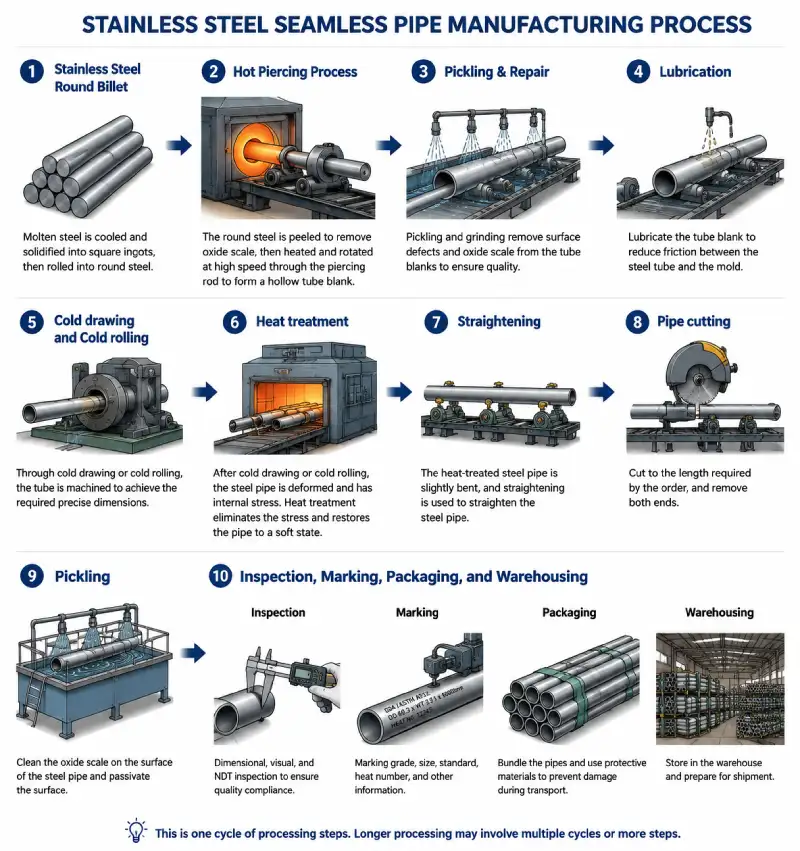
1. Stainless Steel Round Billet
a) The general processing steps start with round steel. The first step is molten steel, which is cooled and solidified into square steel ingots, and then rolled into round steel.
2. Hot Piercing Process
a) There will be a layer of oxide scale on the surface of the round steel. The round steel will be peeled off to remove the oxide scale and the defects and flaws on the surface of the round steel. At this time, the round steel is heated and rotated at high speed through the piercing rod to form a hollow tube blank. This is the prototype of the seamless tube.
3. Pickling & Repair
a) Pickling and grinding are performed on the obtained tube blanks to remove as many defects as possible from the surface of the tube blanks before formal processing, so as not to affect the quality of the finished product.
4. Lubrication
a) The prepared tube blank needs to be lubricated in preparation for subsequent formal processing. Why is lubrication necessary? To reduce friction between the steel tube and the mold, preventing damage to their surfaces.
5. Cold drawing and Cold rolling
a) Machining deformation: producing the required precise dimensions within the mold.
6. Heat treatment
a) After cold drawing or cold rolling, the steel pipe is deformed and its interior is filled with stress. It needs to be heat-treated to eliminate the stress and restore the steel pipe to its soft state.
7. Straightening
a) The heat-treated steel pipe is slightly bent, and straightening is used to straighten the steel pipe.
8. Pipe cutting
a) Cut to the length required by the order, and remove both ends.
9. Pickling
a) Clean the oxide scale on the surface of the steel pipe and passivate the surface.
10. Inspection, Marking, packaging, and warehousing.
This is one cycle of processing steps. If the processing takes longer, it involves multiple cycles or more steps. If you have any questions, feel free to email me and we can discuss it together.